Newark's housing stock is old, and old buildings leak in places that are invisible until the mold shows up on the surface. Parapet flashing on flat-roof row homes fails and routes water inside the masonry cavity. Mortar joints in pre-war brick walls crack and allow rain to saturate the backup wythe. Below-grade apartment walls in the Ironbound District stay damp from groundwater pressure for months at a time. Mold follows wherever that moisture settles, and in a dense Newark building with shared walls and interconnected ventilation pathways, a colony behind one unit's baseboard can affect air quality across the floor. Newark Water Damage builds negative-pressure containment before any material is disturbed, runs HEPA-filtered air scrubbers throughout the remediation, and removes all affected porous materials through the containment without passing spores through the living space. We verify clearance with post-work testing rather than a visual sign-off — the work is not done until the numbers confirm it. Address the moisture source first, then address the mold. Call 551-351-9705.
- IICRC S520 protocol
- Negative-air containment
- HEPA filtration
- Source removal to documented line
- Antimicrobial application
- Optional 3rd-party clearance testing
Why Bleach Does Not Kill Mold (And What Actually Does)
The single most common mold-remediation myth: bleach kills mold. It does not. Bleach is mostly water plus sodium hypochlorite. It can lighten surface staining (which is why people think it worked) but the chlorine evaporates while the water soaks into porous material, feeding the fungal growth underneath. Within weeks the visible mold returns.
What actually works: physical removal of the contaminated substrate. If mold is on porous material (drywall, insulation, untreated wood, carpet pad), remove the material. If mold is on hard non-porous surfaces (sealed concrete, finished wood, ceramic tile), HEPA vacuum + wipe with EPA-registered antimicrobial. Either way, the source moisture has to be eliminated first or the mold returns regardless of what cleaning was done.
Antimicrobial chemicals have a place in our protocol — applied AFTER source removal, on remaining hard surfaces, as a final step before reconstruction. They do not substitute for source removal. A Newark restorer who promises to "spray and seal" without removing contaminated substrate is selling a treatment that fails predictably.
Containment + HEPA Filtration — Why The Plastic Sheeting Matters
If you walk into a mold remediation job and the contractor is not running HEPA-filtered negative-air containment, walk back out and call someone else. Disturbing mold growth releases millions of spores into the air. Without containment, those spores spread throughout the rest of the property — turning a contained 200 sqft mold problem into a whole-house contamination event.
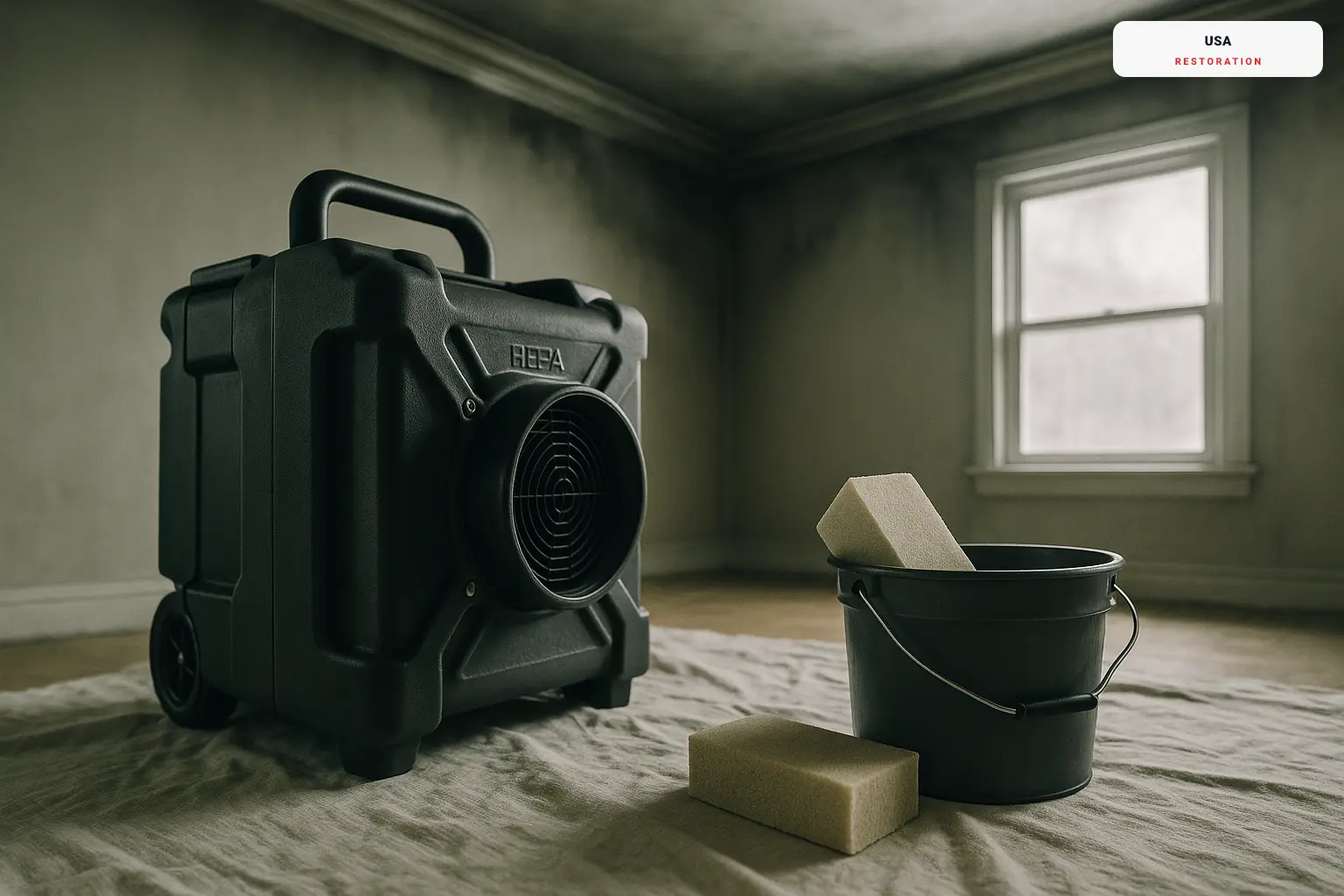
Proper containment: 6-mil plastic sheeting + zip-wall framing creates a sealed barrier between the affected area and the rest of the structure. HEPA-filtered air scrubbers run inside the containment to capture airborne spores during the work. Negative-air pressure differential (containment is at lower pressure than the rest of the structure) means any air leakage flows INTO the containment rather than out. PPE for the techs: Tyvek suits, respirators with P100 cartridges, gloves, foot covers.
This setup adds equipment cost and labor time to a remediation job, which is why fly-by-night operators skip it. The cost difference shows up later — when the contamination has spread to areas it was not in before, and the second remediation is 3-5x the first.
Mold Remediation and the rest of your recovery
A property loss in Newark rarely stays in one lane — mold remediation often overlaps with emergency water mitigation, soot removal, wind damage repair, sewer backup remediation, finish carpentry and rebuild, and our crew handles all of it under one contract. We dispatch the same standard to Elizabeth mold remediation, Jersey City mold remediation, Irvington mold remediation, East Orange mold remediation and everywhere else across Essex County.
If you searched for restoration company near Newark, you have reached a local team — call 551-351-9705 any hour. For background, read Mold vs mildew — when to worry, when to clean it yourself, when to call a pro on our blog, or head back to our Newark home page to see everything we do.